Pakistan Export Guide for International B2B Buyers
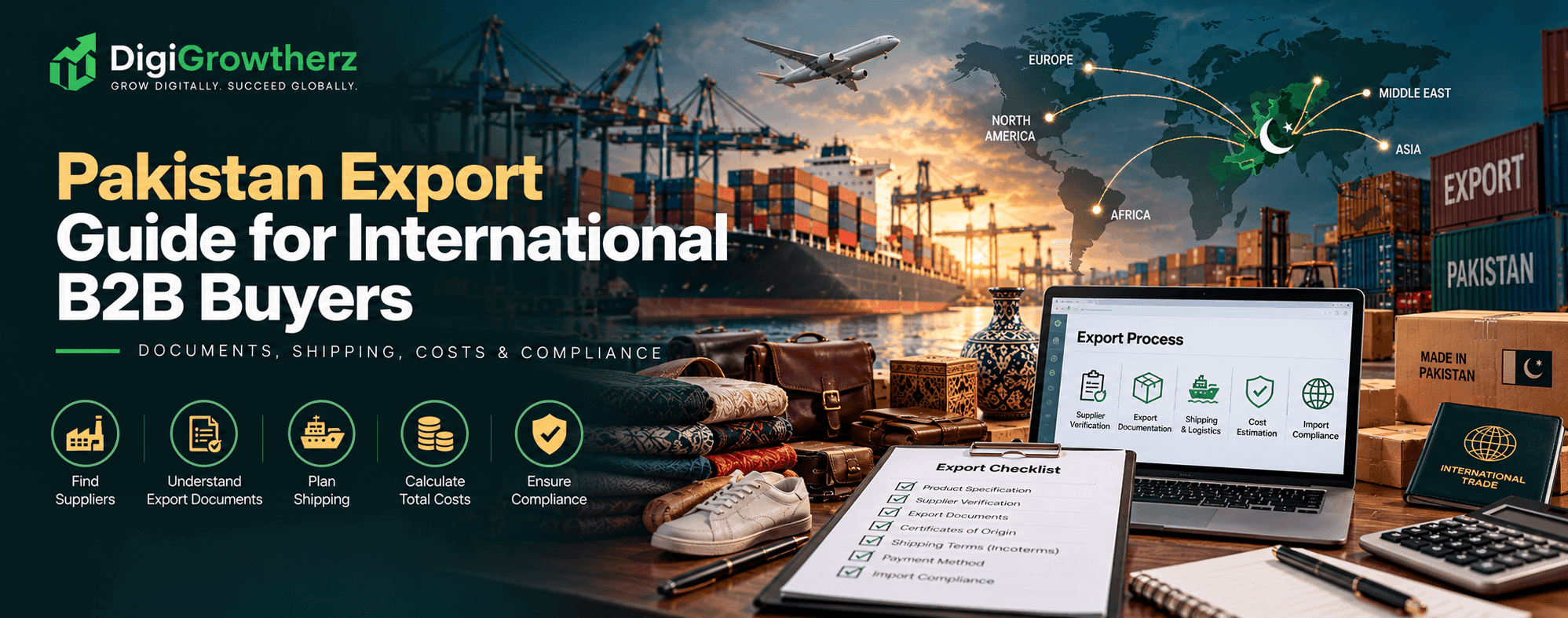
Planning to source products from Pakistan? This practical export guide helps international B2B buyers understand supplier checks, export documentation, shipping terms, payment methods, landed costs, certificates of origin, and destination-market compliance before committing to an order.
D
DigiGrowtherz
DigiGrowtherz
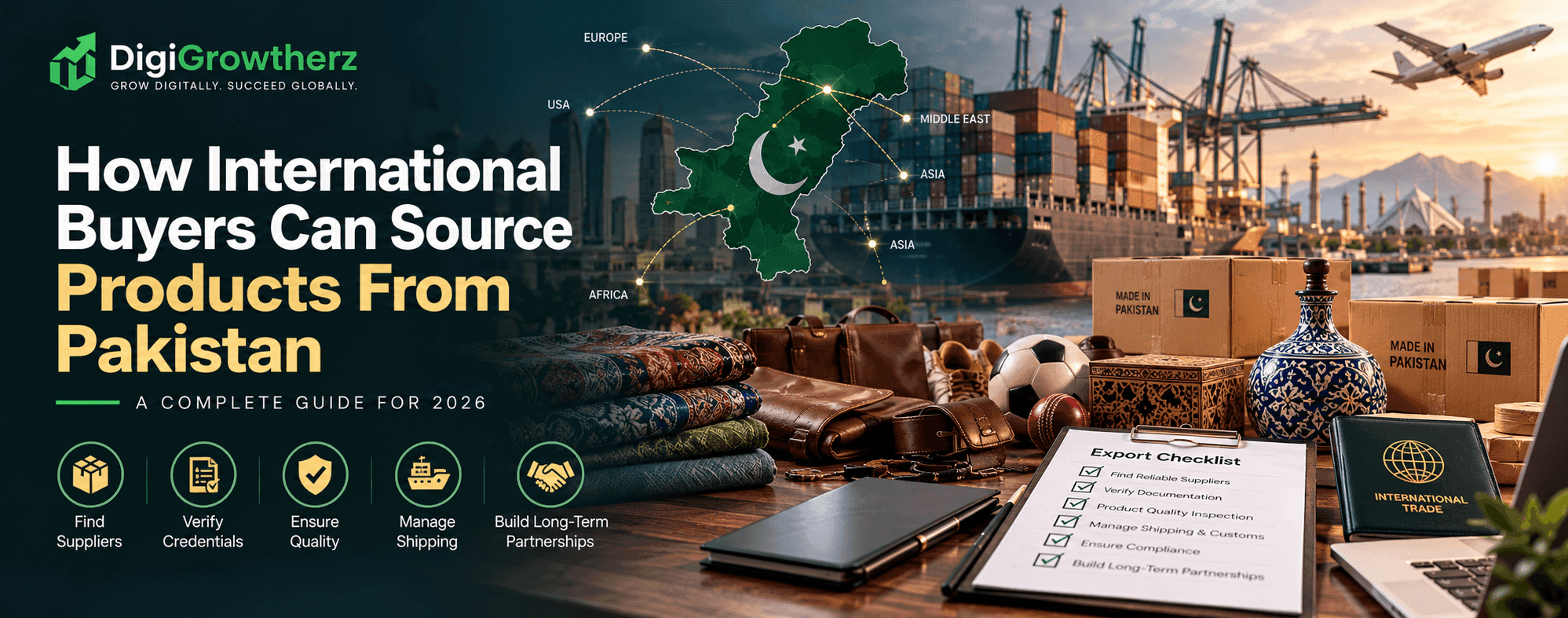
Buying from Pakistan can give international businesses access to a broad range of manufacturers, specialist producers, and export-oriented suppliers. However, finding an attractive product and receiving a competitive quotation are only the first steps in a successful international purchase.
A profitable transaction also depends on verifying the supplier, agreeing on product specifications, understanding export documentation, calculating the full landed cost, arranging suitable shipping, and meeting the import requirements of the destination country.
For example, a buyer may receive a competitive quotation from a Pakistani manufacturer but later discover that the price excludes export packing, shipping insurance, destination duties, or mandatory product testing. These overlooked costs can reduce margins or delay the shipment.
This Pakistan export guide explains the process from an international B2B buyer's perspective. It covers the key decisions to make before ordering, the documents to prepare, the commercial terms to understand, and the checks that help reduce avoidable risks.
The goal is not simply to find a supplier in Pakistan. It is to establish a reliable, commercially sound supply arrangement that works for both parties.
1. Why Consider Pakistan for International Sourcing?
Pakistan has manufacturing and export activity across several industries. Depending on the product and supplier, international buyers can explore opportunities in textiles, apparel, leather goods, sports equipment, surgical instruments, agricultural commodities, food products, home goods, and other manufactured items.
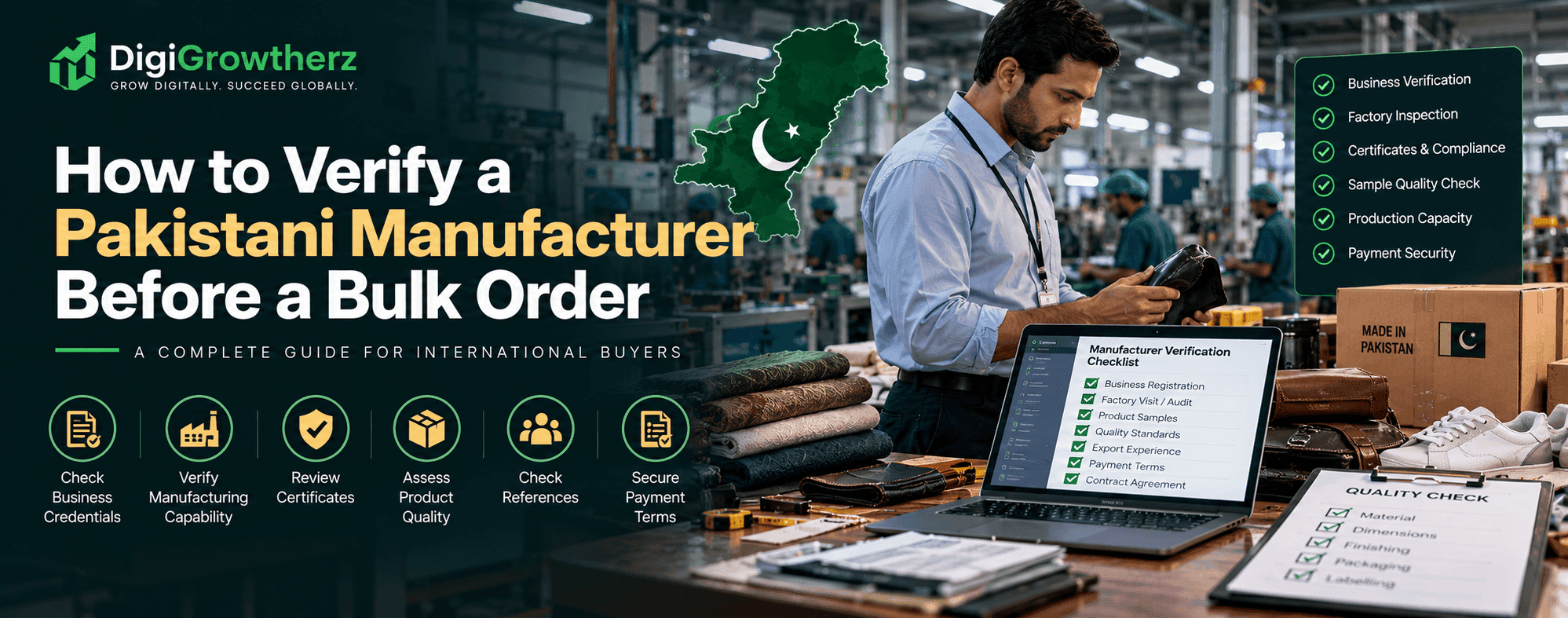
Before committing to a large purchase from Pakistan, verify that the manufacturer is a legitimate business, has the production capacity to fulfil your order, and can consistently meet your quality requirements. This guide explains how international buyers can check business credentials, inspect facilities, validate certificates, test samples, assess payment risks, and protect a bulk order with clear contractual terms.
Pakistan Export Guide for International B2B Buyers | DigiGrowtherz
The suitability of Pakistan as a sourcing destination depends on what a business needs. A supplier may be competitive for a particular product, production run, or material but less suitable for another.
Major product categories to explore
Product category
What international buyers should evaluate
Textiles and apparel
Fabric composition, stitching, sizing, colour consistency, labelling, and testing requirements
Leather goods and accessories
Material quality, finishing, chemical restrictions, durability, and traceability
Sports goods
Performance specifications, materials, safety requirements, and production consistency
Surgical and precision instruments
Technical specifications, manufacturing controls, applicable registrations, and destination-market regulatory requirements
Materials, dimensions, surface finish, packaging, durability, and relevant safety standards
These are starting points for product research, not guarantees that every supplier can meet every requirement. Capabilities, certifications, lead times, and export experience should be verified for the specific product.
Look beyond the quoted price
A low unit price does not automatically make a supplier the best commercial choice. Buyers should also consider minimum order quantities, production capacity, defect rates, communication, delivery reliability, payment terms, and the total cost of bringing the goods into their own market.
A slightly higher quotation may represent better value if it includes appropriate packaging, consistent quality, and more predictable delivery.
2. Define Your Product Requirements Before Requesting Quotations
One of the most common causes of sourcing problems is requesting a price before defining exactly what is being purchased.
Descriptions such as “premium cotton T-shirts,” “sports gloves,” or “stainless steel instruments” can mean very different things to different suppliers. Without detailed specifications, quotations may not be directly comparable.
Before contacting manufacturers, prepare a product brief covering the following details:
Product name, intended use, and technical specifications.
Materials, dimensions, colours, grades, and permitted tolerances.
Required quality standards and any applicable test methods.
Order quantity, estimated repeat-order volume, and delivery deadline.
Packaging, labels, barcodes, cartons, and branding requirements.
Destination country and any mandatory import requirements.
Sample approval process and acceptance criteria.
For customised products, include drawings, reference images, material specifications, or a detailed product specification sheet where appropriate.
Confirm the HS code and classification
Goods traded internationally are classified under the Harmonized System (HS). The classification helps customs authorities determine how products should be identified and can affect applicable duty rates, restrictions, and documentation requirements.
Do not rely entirely on a supplier's suggested code. Ask for the proposed classification and confirm it with a qualified customs broker or the relevant customs authority in the importing country.
A product's trade name may not be enough to determine its correct classification. Material composition, function, construction, and intended use can affect how it is classified.
Getting the classification right early helps buyers estimate import costs and identify compliance requirements before placing an order.
3. Find and Verify the Right Pakistani Exporter
Once the product brief is ready, begin identifying suitable manufacturers or exporters. Trade directories, industry associations, trade fairs, referrals, and B2B platforms can all help generate leads.
However, appearing in a directory or having an impressive website does not prove that a supplier is suitable for your order.
Check business identity and export experience
Ask the prospective supplier for its registered business name, business address, relevant registration or tax details, business contact information, and experience exporting your product category.
Where practical, check the supplied information against appropriate official records. Request references from customers in comparable markets, especially for large or repeat orders.
Confirm whether the company manufactures the goods itself, uses subcontractors, or acts as a trading company. A trading company can still be a suitable partner, but you should understand who is responsible for production, inspections, and resolving defects.
Assess production capability
Ask about realistic production capacity, current commitments, manufacturing lead times, quality-control procedures, and contingency plans for material shortages or equipment problems.
Request representative samples before approving bulk production. For a significant order, consider an independent factory inspection or pre-shipment inspection based on an agreed checklist.
The inspection criteria should relate to your specific product rather than a generic claim that the factory follows high standards.
For a more detailed checklist, read our guide on how to verify a Pakistani manufacturer's suitability before a bulk order. DigiGrowtherz's digital services can also help businesses present their products and capabilities professionally, but supplier verification itself requires appropriate commercial due diligence.
4. Understand Pakistan's Export Process and Official Systems
International buyers do not usually need to manage every Pakistani export filing personally. The exporter, its bank, and its customs agent typically coordinate the relevant formalities. Nevertheless, buyers should understand the process well enough to agree on responsibilities and request the right evidence.
Pakistan uses the Pakistan Single Window (PSW) to facilitate trade-related procedures. Its electronic services include export declarations and processes involving relevant government agencies.
According to the official PSW Single Declaration – Export guidance, exporters or authorised customs agents can submit export declaration information through the platform. The process involves trade and consignment details, financial instrument information, commodity information, and supporting documents as required.
The exporter also needs to meet the applicable registration and banking requirements. Buyers should not assume that the digital platform removes every regulatory obligation; product-specific permissions, certificates, and other formalities may still apply.
What should an international buyer confirm?
Before production or shipment, agree with the supplier on:
Which party will arrange export clearance and the customs declaration.
Who will prepare and provide the commercial invoice and packing list.
Whether the product needs a certificate of origin, export permit, test report, or other specific documents.
Which party will coordinate freight bookings and transport documents.
How payment instructions and documentary requirements will be handled through the agreed banking arrangement.
The Ministry of Commerce's official SRO and notification page is also useful when checking for regulatory updates. The applicable requirements depend on the product and transaction.
5. Know Which Export Documents You Need
Documentation is one of the most important parts of an international B2B transaction. Inaccurate or inconsistent documents can create customs questions, delay cargo release, complicate payment, or prevent a buyer from claiming a tariff preference.
There is no universal document list for every shipment. Requirements vary according to the product, origin arrangement, transport method, payment instrument, destination country, and any applicable regulatory controls.
Common documents used in export transactions
Document
Purpose
Commercial invoice
Records the goods sold, quantities, unit prices, total value, currency, and other transaction details
Packing list
Describes the shipment's packages, contents, weights, and dimensions
Export customs declaration
Provides shipment and commodity information for customs processing
Bill of lading or air waybill
Provides transport documentation for sea or air shipments, respectively
Certificate of origin or other origin evidence
Supports a declaration about where the goods originate, where required
Product-specific certificates or permits
Demonstrate compliance with applicable requirements, such as health, safety, technical, or quarantine rules
Insurance certificate or policy
Provides evidence of cargo insurance where insurance is arranged and documented
Contract or purchase order
Records the agreed commercial terms between buyer and seller
Depending on the transaction, banks and customs authorities may also require particular forms, declarations, certificates, or supporting records.
Check that the documents agree
Ask the supplier to confirm the product description, quantities, currency, consignee details, package counts, weights, and shipment terms before final documents are issued.
These details should be consistent across the invoice, packing list, transport document, customs declaration, and relevant certificates, subject to each document's specific requirements.
Do not assume that a standard template will satisfy every destination's rules. Your customs broker should confirm the documents needed for the actual product and route before shipment.
6. Understand Certificates of Origin and Preferential Tariffs
A certificate of origin or another accepted origin declaration provides evidence about a product's origin. It can be important for customs clearance and may be needed when an importer wants to claim preferential tariffs under an eligible trade arrangement.
However, a product shipping from Pakistan does not automatically qualify for a reduced customs duty.
Eligibility depends on the applicable agreement or trade scheme, product-specific rules of origin, and the evidence required under that arrangement. Those rules may consider where the product was obtained, the materials used, and the processing performed.
For example, a product made in Pakistan using imported materials might qualify under one origin rule but fail another rule requiring a particular level of local processing.
Pakistan's TDAP explains its origin-certification procedures. Depending on the arrangement, origin documents may be issued through an official process or under an applicable self-certification system.
What buyers should do
First, confirm the product's HS classification and the tariff treatment available in the destination market. Then determine whether a preferential arrangement applies and what evidence is required.
Ask the exporter to confirm whether it can provide the necessary origin documentation. If a reduced tariff is important to the purchase, obtain confirmation from a customs broker or the importing country's customs authority before calculating your final margins.
Do not build a quotation around a tariff concession until the product's eligibility has been checked.
7. Compare Quotations Using the Total Landed Cost
The product price is only one part of the import cost. To compare suppliers accurately, calculate the total landed cost—the expected cost of purchasing the goods and getting them to the agreed destination, including relevant freight, insurance, duties, taxes, and handling charges.
Depending on the transaction, the calculation may include:
Product unit price and customisation or tooling charges.
Export packaging, labels, and inspection fees.
Inland transport and export-clearance charges.
International freight and applicable fuel or handling surcharges.
Cargo insurance, where arranged.
Customs duties, import taxes, brokerage, and port or terminal charges.
Destination delivery, storage, and potential demurrage or detention.
Currency conversion costs, bank fees, and other transaction expenses.
Testing, certification, or compliance costs not included in the quotation.
Not every charge applies to every order. The objective is to identify which costs apply and who is responsible for each one.
A simple comparison example
Imagine two suppliers quote different prices for the same product. Supplier A is cheaper per unit but excludes export packing and inland freight. Supplier B charges more per unit but includes those services.
Supplier A may still be the better deal, but the unit prices alone cannot establish that. Add the relevant costs, confirm the delivery terms, and compare the expected landed costs on the same basis.
Also account for possible changes in freight prices, exchange rates, duties, and delivery schedules. Use current quotes for time-sensitive costs rather than relying on old estimates.
8. Learn the Basics of Incoterms 2020
Incoterms® rules, published by the International Chamber of Commerce (ICC), define certain responsibilities of buyers and sellers in international and domestic sales contracts. They help clarify delivery, allocation of costs, and the point where risk transfers between the parties.
They do not independently determine ownership of the goods, payment terms, product quality, or the entire contract.
The rules should be written with a precise named place or port and the applicable version, for example, “FCA [named place], Incoterms® 2020.”
Common terms buyers may encounter
Term
Practical meaning
EXW — Ex Works
The seller makes the goods available at the named place. The buyer takes on extensive responsibilities, including export clearance where applicable under this rule.
FCA — Free Carrier
The seller delivers the goods to the agreed carrier or other named point and handles export clearance as required by the rule.
FOB — Free On Board
Used for sea and inland-waterway transport; the seller delivers the goods on board the nominated vessel at the named port of shipment.
CIF — Cost, Insurance and Freight
Used for sea and inland-waterway transport; the seller pays freight and specified insurance to the named destination port, although risk transfers when the goods are on board at shipment.
CPT — Carriage Paid To
The seller pays carriage to the named destination, but risk transfers when the goods are handed to the carrier under the rule.
CIP — Carriage and Insurance Paid To
The seller pays carriage and insurance to the named destination, while risk transfers when the goods are handed to the carrier.
DAP — Delivered at Place
The seller delivers the goods to the agreed destination, ready for unloading; the buyer generally handles import clearance and related import duties and taxes.
DDP — Delivered Duty Paid
The seller assumes extensive responsibilities, including import clearance and applicable duties and taxes, subject to the rule and legal ability to fulfil those obligations.
For sea freight, FOB or CIF may be considered, but they are not universal solutions. For containerised cargo or multimodal transport, FCA, CPT, or CIP may be more appropriate depending on how delivery is arranged. DAP and DDP can be relevant where delivery to a destination is part of the seller's offer.
A low-friction arrangement is not necessarily the lowest-cost arrangement. Before selecting a term, confirm the named location, who books the carrier, where risk transfers, who arranges insurance, and who handles customs formalities.
For DDP in particular, confirm that the seller can legally act as the importer or otherwise fulfil destination-country import obligations. Do not assume every overseas supplier can do this.
9. Choose a Suitable Shipping Method
Shipping decisions affect cost, delivery time, handling requirements, and the risk of delays. The right method depends on shipment size, product value, urgency, destination, and the buyer's inventory needs.
Sea freight
Sea freight is often suitable for larger or heavier consignments where cost per unit matters more than speed. Full Container Load (FCL) gives a buyer the use of an entire container, whereas Less than Container Load (LCL) consolidates cargo with other shipments.
LCL may suit smaller orders, but consolidation, handling, and destination charges can affect its overall value. Compare the full quote rather than freight alone.
Air freight
Air freight can be useful for urgent, high-value, or relatively lightweight products. It is generally more expensive than sea freight for comparable cargo, so calculate whether faster delivery justifies the added cost.
Courier services may be suitable for samples and small parcels, subject to product restrictions and destination requirements.
Confirm the shipping plan in advance
Ask the supplier or freight forwarder to confirm the planned route, estimated transit time, shipment cut-off dates, cargo dimensions, weights, packaging requirements, and expected destination charges.
Transit estimates are not guarantees. Port congestion, customs inspections, missed connections, carrier changes, weather, and documentation errors can cause delays.
For time-sensitive inventory, build a reasonable buffer and agree how the supplier will communicate changes.
Protect against cargo damage
Packaging should fit the product and transport route. Fragile goods may need protective inserts or stronger cartons; moisture-sensitive goods may need suitable moisture protection; food or other regulated products may have additional packaging and handling requirements.
Agree on carton markings, labels, palletisation, and packing standards before bulk production starts. Consider insurance that matches the shipment's value and risks, and read its exclusions and claims requirements carefully.
10. Agree on Payment Terms and Protect the Transaction
Payment terms affect cash flow and risk for both parties. The right arrangement depends on order size, the buyer's relationship with the exporter, the supplier's financial position, the banking arrangements, and the parties' risk tolerance.
Common approaches include:
Advance payment: The buyer pays before production or shipment, fully or partly. This may help the supplier purchase materials, but increases the buyer's exposure if the supplier does not perform.
Deposit and balance: The buyer pays a deposit and the remaining amount at an agreed production, inspection, or shipping milestone. The contract must define exactly what evidence triggers the balance.
Letter of credit (L/C): A bank undertakes to pay the beneficiary when the specified documentary conditions are met, subject to the terms of the credit. It can provide structure, but documentary discrepancies and bank fees matter.
Documentary collection: Banks handle the exchange of shipping documents for payment or acceptance under agreed instructions. This is not the same as a bank guarantee that the buyer will pay.
Open account: Goods are shipped before payment is due. This can be useful in an established relationship but may expose the seller to greater non-payment risk.
No payment method eliminates every commercial risk. For example, an L/C primarily works with stipulated documents; it does not automatically guarantee that the physical goods are defect-free.
Practical safeguards
Use a written contract or purchase order with clear product specifications, quantities, prices, currency, payment milestones, inspection criteria, delivery dates, Incoterms, and remedies for non-performance.
Verify bank details independently, especially if payment instructions change by email. Unexpected changes should be confirmed through a previously verified contact channel before funds are sent.
For Pakistani exporters, banking and receipt-of-export-proceeds requirements are governed by applicable State Bank of Pakistan regulations. The exporter should confirm the current requirements with its authorised bank and consult the SBP Foreign Exchange Manual when needed.
11. Check Import Compliance in Your Own Country
Export clearance from Pakistan does not automatically mean the goods can enter the destination market without additional checks.
The importing country may impose requirements for product safety, labelling, packaging, restricted substances, food safety, plant or animal health, medical-device regulation, product registration, or other controls. These obligations vary by product and market.
For example, a food shipment may require health or phytosanitary documents, while a product marketed as a medical device may be subject to specific regulatory controls. A general quality certificate is not necessarily a substitute for a mandatory product approval.
What should buyers confirm?
Before placing the order, identify:
The correct product classification and applicable duty rate.
Any import licence, registration, testing, or certification requirements.
Required labels, language, warnings, and packaging information.
Origin documentation needed for normal or preferential tariff treatment.
Whether the proposed product, material, or component is subject to restrictions.
The documents needed for customs clearance and any post-market obligations.
Use official customs, trade, and product-regulatory resources for the destination market, supplemented by a qualified local customs broker or compliance specialist.
The buyer and seller should also agree who pays for mandatory testing, corrections, re-labelling, or other steps if the goods do not meet the agreed destination-market requirements.
12. Build Quality Assurance Into the Purchase Order
Quality disputes are much harder to resolve once goods have been shipped internationally. Buyers should define acceptance criteria before production begins.
For a new supplier or a customised product, request a sample and approve a written reference sample or documented specification. Confirm how production variations will be assessed, which defects are acceptable, and how non-conforming items will be handled.
For larger orders, a pre-shipment inspection can help identify issues before cargo leaves the factory. The parties should agree on the inspection scope, sampling method, timing, and consequences of a failed inspection.
Keep records of approved samples, drawings, specifications, test results, inspection reports, and written changes. If the buyer changes a requirement, the supplier should confirm the impact on price, lead time, materials, and compliance in writing.
Quality assurance is not only about reducing defects. It also helps make repeat orders more consistent and protects the buyer's reputation with its own customers.
13. Common Mistakes International Buyers Should Avoid
Even an experienced buyer can encounter unnecessary costs when important details are left unresolved.
Choosing on price alone: Compare the landed cost, quality controls, payment terms, and delivery capability—not just the unit price.
Assuming all exporters are manufacturers: Confirm who produces the goods and who is responsible for subcontractors and quality.
Using vague product specifications: Agree on measurable requirements and approval procedures before production.
Assuming the supplier handles every import requirement: Clarify export and import responsibilities under the contract and delivery term.
Treating a certificate of origin as an automatic tariff discount: Check the product-specific origin rules and acceptable proof before claiming preferential treatment.
Using Incoterms without a named location: Specify the place or port precisely and state that the contract uses Incoterms® 2020.
Ignoring destination charges: Ask for a complete landed-cost estimate and verify local brokerage, port, tax, and delivery charges.
Relying on verbal promises: Put key terms, payment triggers, inspection rights, and defect remedies into writing.
14. A Practical Checklist Before Your First Order
Use this checklist to make sure the essential commercial decisions have been covered before releasing a purchase order.
Product specifications, quantities, packaging, and labels are confirmed.
The supplier's legal identity, production capability, and references have been checked.
Samples and quality acceptance criteria are approved.
HS classification, import duties, and destination-market requirements have been reviewed.
Export documents and any required certificates have been identified.
The Incoterms® 2020 rule and named place or port are stated in writing.
Freight, insurance, and destination charges have been considered in the landed-cost estimate.
Payment milestones and verified bank details are agreed.
Inspection arrangements, delivery dates, and remedies for defects are documented.
The supplier and buyer know who is responsible for each export and import step.
This does not replace product-specific legal, customs, or tax advice, but it provides a practical starting point for a more controlled B2B transaction.
15. Why a Professional Digital Presence Matters for Exporters
Export readiness is not only about manufacturing and paperwork. Overseas buyers also need to understand what a company produces, whether it can meet their requirements, and how to contact the right team.
A clear website, detailed product pages, downloadable specifications, professional branding, and accessible enquiry forms can make it easier for potential buyers to evaluate a business before starting discussions.
A website cannot replace business verification, product testing, certifications, or sound commercial terms. It can, however, help a legitimate exporter communicate its capabilities and respond to international enquiries more effectively.
The most useful digital strategy is one that supports the real buying process: helping prospective customers discover relevant products, access accurate information, ask informed questions, and take the next step with confidence.
Conclusion
Pakistan can be a valuable sourcing destination for international B2B buyers, but successful importing requires more than finding a manufacturer and agreeing on a price. Product specifications, supplier capability, export documentation, Incoterms, payment arrangements, freight, and destination-market compliance all influence the final outcome.
The best approach is to clarify requirements early, verify important details, compare suppliers using total landed cost, and put responsibilities into a written agreement. Confirm product-specific rules with the relevant authorities and qualified professionals, especially when duties, certification, or regulatory approvals could affect the order.
A structured process reduces avoidable surprises and gives both parties a clearer basis for building a long-term supply relationship.
For international buyers, the objective is simple: make informed decisions before committing money, protect the shipment through clear terms, and build supplier relationships that can support consistent business growth.
Pakistan offers sourcing opportunities across textiles, leather goods, sports equipment, surgical instruments, agricultural products, and other manufacturing sectors. This practical guide explains how international buyers can identify Pakistani exporters, verify suppliers, evaluate product quality, calculate landed costs, manage shipping and payments, and prepare for destination-market regulations.
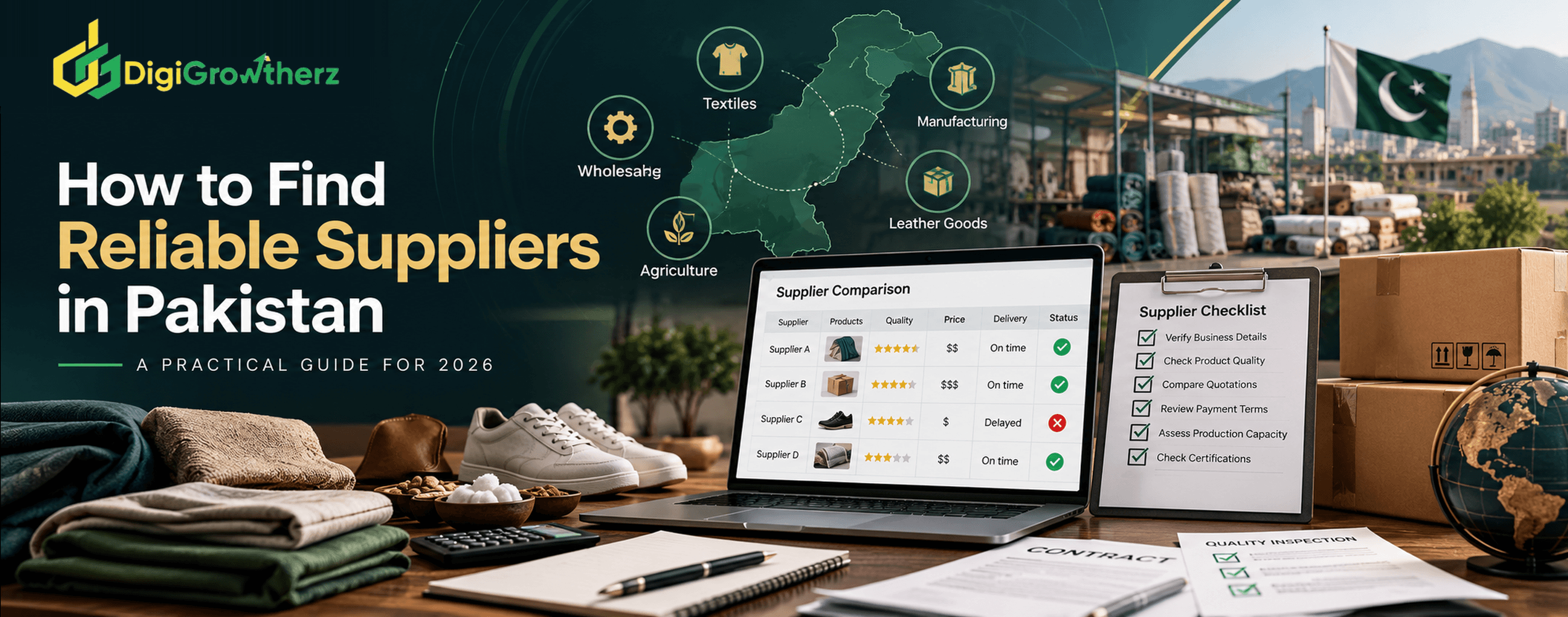
Looking for trustworthy manufacturers, wholesalers, or product suppliers in Pakistan? Learn how to find potential suppliers, verify business credentials, assess product quality, compare quotations, negotiate terms, and reduce the risk of unreliable deliveries or financial losses.