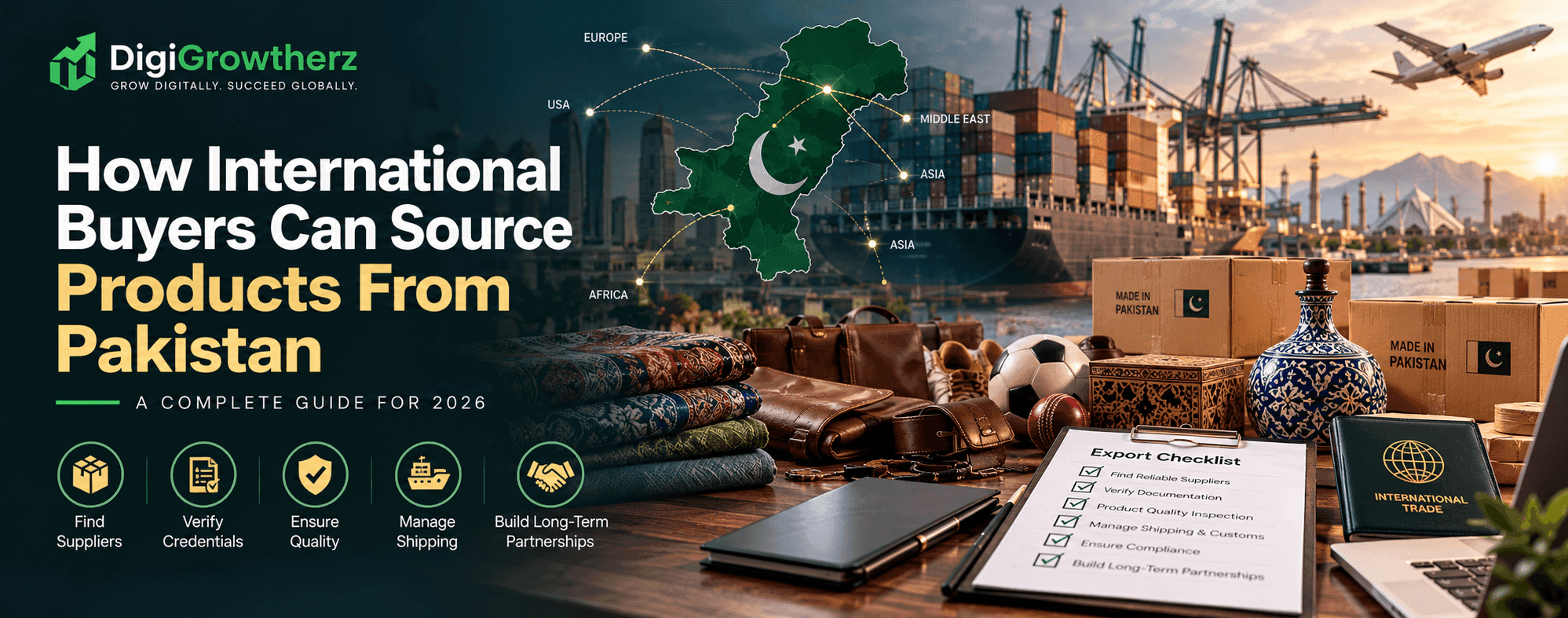
How International Buyers Can Source Products From Pakistan
Pakistan offers sourcing opportunities across textiles, leather goods, sports equipment, surgical instruments, agricultural products, and other manufacturing sectors. This practical guide explains how international buyers can identify Pakistani exporters, verify suppliers, evaluate product quality, calculate landed costs, manage shipping and payments, and prepare for destination-market regulations.
D
DigiGrowtherz
DigiGrowtherz
International sourcing can help businesses diversify their supply chains, find specialized manufacturers, and explore new product opportunities. For buyers looking beyond their domestic markets, Pakistan offers a range of manufacturing and agricultural industries worth investigating.
However, finding a product that looks suitable online is only the beginning. Successful international sourcing also requires supplier verification, sample approval, price negotiation, payment planning, shipping coordination, and compliance with the rules of the destination market.
A quotation that appears competitive may become expensive once freight, insurance, customs duties, inspection, and other charges are included. Similarly, a supplier that produces an excellent sample may not consistently meet the requirements of a larger order.
The goal is not simply to find a Pakistani supplier. It is to build a sourcing process that delivers the right product, at an acceptable total cost, with manageable commercial and compliance risks.
This guide walks international buyers through the process of sourcing products from Pakistan, from choosing a product category to receiving the shipment and developing a long-term supplier relationship.
Why Consider Sourcing Products From Pakistan?
Pakistan has established industries serving domestic and international markets, with businesses operating in manufacturing, agriculture, textiles, consumer goods, and other product categories.
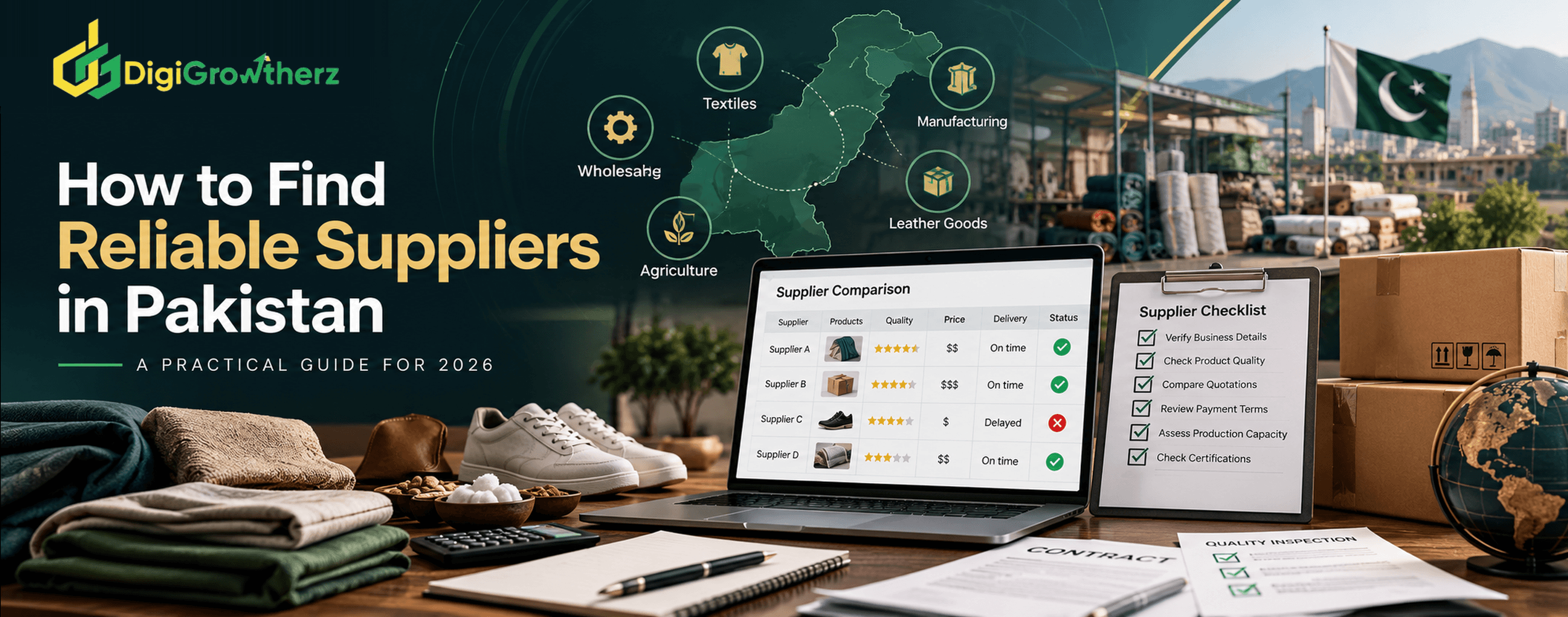
Looking for trustworthy manufacturers, wholesalers, or product suppliers in Pakistan? Learn how to find potential suppliers, verify business credentials, assess product quality, compare quotations, negotiate terms, and reduce the risk of unreliable deliveries or financial losses.
How International Buyers Can Source Products From Pakistan | DigiGrowtherz
Potential sourcing opportunities include:
Textiles and apparel: Fabric, garments, home textiles, and related products.
Leather goods: Leather accessories, footwear, and other finished goods.
Sports goods: Equipment, balls, protective products, and related items.
Surgical and medical instruments: Products that may be subject to strict destination-market requirements.
Agricultural and food products: Selected produce, grains, spices, and processed goods.
Furniture and home products: Selected furnishings, decorative items, and household goods.
Metal products and manufacturing components: Depending on the capabilities of individual manufacturers.
These categories are starting points for research, not guarantees that every supplier can meet a buyer's quality, volume, price, or compliance requirements.
Evaluate the supplier, not just the country's reputation
A country's established industry can help you identify where to look, but it does not establish the reliability of an individual factory or exporter.
Before committing to an order, investigate the specific supplier's production capability, export experience, quality-control process, documentation, and ability to deliver your requirements.
For international buyers, a well-matched supplier with consistent quality and clear commercial terms is generally more useful than a supplier selected solely because its country or industry has a strong reputation.
1. Define Your Product and Import Requirements
Before searching for suppliers, establish precisely what you want to buy and what is required to sell or use that product in your destination market.
Vague requirements lead to vague quotations. If suppliers make different assumptions about materials, specifications, packaging, or quality, the prices you receive may not be comparable.
Prepare a product specification
Your specification should describe:
Product type, materials, dimensions, and technical characteristics.
Required quantities and expected repeat-order volumes.
Packaging, labelling, branding, and customization.
Product quality standards and acceptable tolerances.
Expected delivery schedule.
Required inspection, testing, or certification.
Target price range and intended destination.
For example, a buyer sourcing sportswear should define fabric composition, weight, sizing, stitching, colour consistency, logos, packaging, and acceptable defect levels.
For food products or regulated equipment, additional information such as ingredients, shelf life, safety requirements, testing, and destination-specific documentation may be essential.
Identify the applicable product classification
International trade commonly uses Harmonized System (HS) codes to classify products for customs purposes. The classification can affect applicable tariffs, import restrictions, licences, documentation, and trade measures.
Do not rely solely on a supplier's suggested code. Confirm the classification using the customs authority or official tariff resources relevant to your destination.
If the classification is uncertain or the commercial stakes are high, consult a qualified customs broker or trade professional before finalizing the order.
2. Find Pakistani Exporters Through Reliable Channels
A good supplier search begins with a shortlist of plausible candidates rather than a commitment to the first company that responds.
Combine official directories, trade organizations, industry networks, referrals, exhibitions, and direct research to identify exporters whose capabilities match your requirements.
Use the Pakistan Exporters' Directory
The Trade Development Authority of Pakistan (TDAP) maintains the Pakistan Exporters' Directory, designed to help foreign buyers discover Pakistani exporters by product category, HS code, and company name.
The directory is a useful starting point, but it should not replace due diligence. Its information page notes that the version described there was based on Pakistan Customs export data for calendar year 2016, so buyers should independently verify a supplier's current operating status, export activity, and product capabilities.
Explore trade exhibitions and industry networks
Sector-specific trade exhibitions, chambers of commerce, industry associations, and business referrals can help you discover suppliers and compare products.
Trade events are especially useful when you need to inspect samples, discuss manufacturing specifications, or understand a supplier's production capabilities.
TDAP provides information about exporter support and trade-promotion activities through its official website.
When using referrals, ask the referrer about the supplier's actual performance: product consistency, communication, delivery reliability, and handling of defects or disputes.
Use online research to expand your shortlist
Supplier websites, B2B marketplaces, and professional networks can help you find additional candidates.
However, an attractive website, impressive photographs, or a large online following does not prove that a business owns a factory, maintains inventory, or has the capacity to fulfil your order.
Use online platforms to discover candidates, then verify them using independent evidence.
3. Verify the Supplier Before Negotiating a Large Order
Supplier verification is essential when dealing with a business you have not worked with before.
The purpose is to establish who you are buying from, what the supplier actually does, and whether it can meet the requirements of your transaction.
Confirm the business identity
Request appropriate business information, such as:
Legal or registered business name.
Business address and official contact details.
Company registration details, where applicable.
Tax registration information, where relevant.
Identity and authority of the person negotiating the order.
References or evidence of previous export transactions.
The precise documents available will depend on the supplier's legal structure. Not every legitimate sole proprietorship is an incorporated company.
Registration or taxpayer status alone does not prove product quality, financial strength, or reliability.
Establish whether it is a manufacturer or intermediary
Ask whether the company manufactures the products itself, buys them from other factories, or operates as a trading company.
A trading company can be a suitable supplier, especially if it coordinates multiple product categories or handles export documentation. The important point is to understand its role and responsibilities.
If direct factory access matters to your purchase, request a factory visit or a live video walkthrough. For high-value orders, consider an independent assessment rather than relying exclusively on the supplier's own description.
Assess relevant experience
Ask for examples of similar products, markets served, order sizes handled, and quality-control processes.
Where references are available, seek feedback from previous buyers about consistency, communication, shipping documentation, and dispute resolution.
A supplier should be able to explain how it will fulfil your order—not merely promise that it can.
4. Request Samples and Confirm Quality
A sample allows you to evaluate a product before committing to bulk production or a large purchase.
It is particularly important for customized products, textiles, leather goods, sports equipment, components, and any item where materials or finishing significantly affect its value.
Agree on the sample requirements
Before ordering samples, specify what you will evaluate, including material, dimensions, performance, appearance, packaging, and required standards.
For customized goods, request a representative sample that reflects the intended production specification. Once approved, document the sample details and any permitted tolerances so they can be referenced in the purchase agreement.
Consider independent inspection and testing
For larger orders, safety-sensitive products, or regulated categories, an independent pre-shipment inspection may reduce risk.
Depending on the product, inspection might cover quantities, appearance, dimensions, labelling, packaging, and workmanship. Laboratory testing may be appropriate when compliance depends on chemical, mechanical, electrical, microbiological, or other technical characteristics.
Do not assume every product requires the same certificates. Verify the actual requirements for the product and destination market.
For example, the European Commission's Access2Markets product-requirements guidance explains that requirements vary by product and market and may involve safety, health, environmental, labelling, or other controls.
Sample approval is important, but it does not guarantee that every unit in a bulk order will match the sample. Define production standards and decide how conformity will be checked.
5. Compare Quotations Using Total Landed Cost
A factory quotation is only one part of the cost of an international purchase.
The total amount paid to obtain a usable shipment can include product costs, packaging, inland transport, export handling, international freight, insurance, import duties, taxes, customs clearance, inspection, and destination delivery.
Not every cost applies to every transaction. The contract and delivery terms determine how specific costs are allocated.
Ask each supplier for a comparable quotation
Make sure every candidate is quoting against the same product specification, quality level, order quantity, packaging, and delivery destination.
Request clear information about:
Unit price and total order value.
Minimum order quantity.
Sample, mould, or tooling charges.
Packaging and labelling costs.
Production lead time.
Payment terms.
Shipping method and quoted delivery terms.
Export documentation and inspection arrangements.
Defect, replacement, or shortage policies.
A cheaper unit price may not provide the best overall value if the product has higher defect rates, longer lead times, or expensive transport requirements.
Calculate your landed cost
For planning purposes, build a cost sheet that separates:
Product cost + origin-side costs + international transport and insurance + destination charges + applicable duties and taxes + other transaction costs.
Use verified estimates rather than assuming that a supplier's shipping quote includes customs duties or final delivery.
For a large order, ask a freight forwarder or customs broker to estimate the charges that apply to the destination and shipping arrangement.
This lets you compare suppliers on a more realistic basis and calculate whether the product remains commercially viable after importation.
6. Understand Shipping Terms and Incoterms
International shipments can involve multiple parties, including the supplier, freight forwarder, shipping line or airline, customs broker, insurer, and buyer.
Before placing an order, clarify who arranges and pays for transportation, where the goods are considered delivered, who handles export and import formalities, and where the risk transfers between seller and buyer under the agreed terms.
The International Chamber of Commerce publishes the Incoterms® rules to define important buyer and seller responsibilities, costs, and risks in goods transactions.
The published Incoterms® 2020 rules include terms such as EXW, FCA, FOB, CIF, CPT, CIP, DAP, and DDP, among others. These rules are not interchangeable; the appropriate choice depends on the transport mode and the commercial arrangement.
For example, FOB and CIF are intended for sea and inland waterway transport, while rules such as FCA, CPT, CIP, DAP, and DDP can be used for different transport modes according to their terms.
Avoid choosing a shipping term merely because it is familiar. Confirm that it suits your shipment and that the named delivery point or port is clear.
Incoterms allocate certain delivery responsibilities, costs, and risks, but they do not by themselves settle every aspect of a sales contract, such as ownership transfer, payment terms, or remedies for breach.
Choose the shipping method carefully
Sea freight can be suitable for larger or less urgent shipments, while air freight may make sense for smaller, higher-value, or time-sensitive goods. Courier services are often useful for documents and samples.
Compare more than the quoted freight charge. Transit time, cargo dimensions, packaging, cargo insurance, handling, customs clearance, and destination delivery can all affect the final outcome.
For a new route or product, work with a reputable freight forwarder and confirm the documentation required before the cargo is dispatched.
7. Check Import Regulations in Your Country
One of the most costly sourcing mistakes is ordering goods before confirming that they can be imported and sold in the intended market.
Product regulations differ across countries and categories. Certain items may require licences, conformity testing, product registration, labelling, health or safety certificates, or restrictions on materials and ingredients.
For example, a product accepted in one market may require additional certification or different labelling before it can be placed on the market elsewhere.
Research the destination requirements early
Before confirming the purchase, check:
Correct HS classification.
Applicable customs duties, taxes, and trade measures.
Product safety and technical requirements.
Labelling, packaging, and language requirements.
Import licences or permits, where applicable.
Required certificates and shipping documents.
Restrictions that apply to the product or its components.
Buyers importing into the European Union can consult Access2Markets for information on tariffs, rules of origin, taxes, import procedures, product requirements, and trade barriers.
Buyers in other destinations should consult the relevant customs authority and product regulator in their own country.
For example, requirements for food, cosmetics, electronics, medical products, toys, and agricultural goods can differ substantially. Do not rely on a general statement such as "export quality" as evidence that the product complies with your country's rules.
For regulated products, confirm compliance before production begins so that required testing, documentation, or product changes can be incorporated into the project.
8. Agree on Payment Terms and Protect the Transaction
Payment arrangements affect both buyer and seller risk.
A supplier may request an advance payment to purchase materials, while an international buyer may be reluctant to pay before seeing evidence of production or dispatch.
There is no single payment method suitable for every transaction. The appropriate arrangement depends on the commercial relationship, order value, creditworthiness, country risks, bank fees, and available safeguards.
Understand common international payment methods
Advance payment: The buyer pays before shipment. This can provide assurance to the exporter but creates exposure for a buyer who has not yet received the goods.
Bank transfer against agreed milestones: Payments can be tied to documented stages, where the supplier and buyer agree on workable terms. The evidence for each milestone should be specific and verifiable.
Letter of credit: A bank undertakes to pay against presentation of documents that comply with the credit's terms and conditions. This can help manage risk in some new or higher-risk trade relationships, but it involves bank fees and detailed documentation. A letter of credit is not a guarantee that goods are defect-free.
Open-account terms: Goods are shipped before payment is due. This can help the buyer's cash flow but may be less attractive to a supplier that does not know the buyer's payment history.
The U.S. Department of Commerce's Trade Finance Guide explains common international payment instruments and the risks each seeks to address. Specific options and banking practices will depend on the parties' jurisdictions and institutions.
Verify payment instructions
Check that the account name and payment beneficiary match the agreed supplier or a documented, authorized party.
If payment instructions change unexpectedly, verify the change through a previously established contact method. Be cautious about urgency, unexplained third-party accounts, or requests to bypass agreed procedures.
For high-value purchases, consider obtaining advice from your bank or a trade-finance specialist before agreeing to payment terms.
9. Prepare the Contract and Export Documentation
A written agreement helps prevent disputes by recording what the supplier must deliver and what the buyer must pay.
Include the approved product specifications, quantity, price, currency, packaging, delivery date, payment milestones, inspection process, defect handling, shipping terms, and responsibility for required documents.
Where appropriate, also address confidentiality, intellectual property, cancellation, dispute resolution, and how changes to the order must be approved.
Understand the documents that may be required
Depending on the product, destination, shipping method, and contract, international shipments may require documents such as:
Commercial invoice.
Packing list.
Bill of lading or air waybill.
Certificate of origin, where required.
Export or import declarations.
Inspection, testing, or conformity documents, where applicable.
Health, phytosanitary, or other product-specific certificates, where applicable.
Licences or permits required by the relevant authorities.
This is not a universal checklist for every shipment. Confirm the exact documentation for the product and destination before dispatch.
Pakistan Single Window provides trade-related services and information for cross-border transactions. Its Single Declaration – Export service provides an electronic interface for submitting export declaration information and coordinating clearance-related requirements with relevant agencies.
Buyers should ensure that their Pakistani supplier or appointed export agent understands the documentation responsibilities for the transaction, while the buyer confirms the import requirements in the destination country.
10. Start With a Manageable Order and Build a Long-Term Relationship
After verifying the supplier, approving a sample, and agreeing on commercial terms, consider starting with an order size appropriate to the level of risk.
A first shipment gives you an opportunity to evaluate the supplier's actual performance under real conditions.
Track whether the supplier:
Delivered the agreed quantity and specifications.
Met the planned production and shipping schedule.
Provided accurate documents.
Used the approved packaging and labelling.
Communicated clearly when issues arose.
Resolved shortages or quality problems fairly.
A successful initial order provides useful evidence, but it does not automatically prove that the supplier can scale to much larger volumes.
Increase order size as performance becomes more predictable. For products essential to your business, consider qualifying an alternative supplier to reduce the risk of production disruptions or shortages.
Review supplier performance after each shipment
Maintain records of defects, delays, additional charges, communication problems, and corrective actions.
This makes future decisions more objective and gives both parties a clear basis for improving the process.
A dependable supplier relationship grows through consistent results, transparent expectations, and fair resolution of problems—not just repeated orders.
A Practical Checklist for International Buyers
Before committing to a significant order from Pakistan, make sure you have addressed the following:
Product and market
Product specifications and quantities are clearly documented.
The HS classification and destination-market requirements have been checked.
The product remains commercially viable after estimated landed costs.
Supplier
Business identity and relevant credentials have been checked.
Production or sourcing capability has been assessed.
Samples and quality requirements have been approved.
References or other credible evidence have been reviewed where available.
Commercial terms
Comparable quotations have been evaluated.
Payment terms and milestones are documented.
Applicable Incoterms® and the named delivery point are clear.
Inspection, defects, delays, and dispute handling are addressed in writing.
Shipping and compliance
The shipping method and responsibilities are confirmed.
Required export and import documents have been identified.
Destination duties, taxes, licences, and product regulations have been checked.
The buyer and supplier understand who is responsible for each step.
Risk management
Payment instructions have been verified.
The first order is sized appropriately for the risk.
A process is in place to review the supplier's performance.
Conclusion
Sourcing products from Pakistan can create opportunities for international buyers, but successful importing requires more than finding a competitive supplier.
The strongest process combines product research, supplier verification, sample approval, total-cost analysis, written agreements, appropriate payment arrangements, and a clear understanding of shipping and destination-market requirements.
Start by defining what you need and confirming that the product is suitable for your market. Build a shortlist using credible sources, verify the candidates, test quality, and only commit when the commercial terms and compliance responsibilities are clear.
A well-managed sourcing process protects more than your purchase price: it helps protect product quality, customer relationships, delivery commitments, and long-term profitability.
For businesses exploring international supplier relationships and cross-border growth, DigiGrowtherz offers broader business services. You can learn how we work or contact DigiGrowtherz to discuss your business and digital growth requirements.