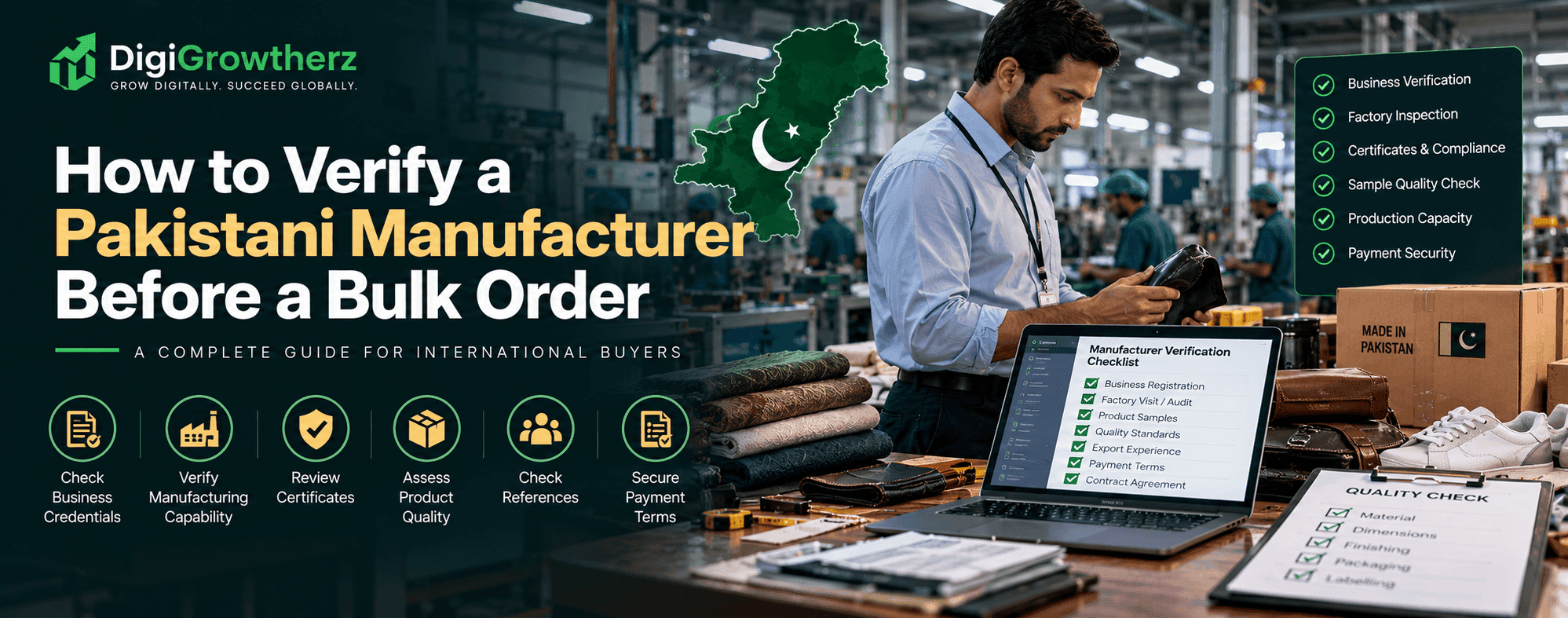
How to Verify a Pakistani Manufacturer Before a Bulk Order
Before committing to a large purchase from Pakistan, verify that the manufacturer is a legitimate business, has the production capacity to fulfil your order, and can consistently meet your quality requirements. This guide explains how international buyers can check business credentials, inspect facilities, validate certificates, test samples, assess payment risks, and protect a bulk order with clear contractual terms.
D
DigiGrowtherz
DigiGrowtherz
A manufacturer may offer an attractive price, provide professional product photographs, and promise fast delivery. But how can you know whether the business can actually manufacture your products to the required standard and deliver the full order on time?
For international buyers, this question becomes especially important before placing a bulk order with a manufacturer they have never worked with.
A supplier may be a legitimate business but lack the machinery, workforce, materials, or available production capacity needed for your order. Another may deliver a good sample but struggle to maintain consistent quality across thousands of units. In other cases, the person negotiating the deal may be a trading agent rather than the manufacturer.
Verifying a manufacturer means checking more than its business registration or online reputation. You need evidence of its identity, operations, product quality, production capabilities, and willingness to accept clear commercial responsibilities.
Pakistan offers sourcing opportunities across textiles, apparel, leather goods, sports equipment, surgical instruments, metal products, and other manufacturing categories. However, suppliers differ in capability and reliability, so each prospective manufacturer should be evaluated on its own merits.
This guide provides a practical due-diligence process for buyers who want to reduce sourcing risks before committing significant money to a bulk purchase.
1. Verify the Manufacturer's Legal Business Identity
Pakistan offers sourcing opportunities across textiles, leather goods, sports equipment, surgical instruments, agricultural products, and other manufacturing sectors. This practical guide explains how international buyers can identify Pakistani exporters, verify suppliers, evaluate product quality, calculate landed costs, manage shipping and payments, and prepare for destination-market regulations.
How to Verify a Pakistani Manufacturer Before a Bulk Order | DigiGrowtherz
Your first step is to establish exactly which business you are dealing with.
A supplier's trading name may differ from its legal name. Its sales representative may use a company email address while asking you to transfer money to an unrelated individual. Its website may also display an address that does not match the business documents it provides.
These discrepancies do not automatically prove misconduct, but they should be resolved before you proceed.
Request the appropriate business documents
Ask the prospective manufacturer for information relevant to its legal structure, such as:
Registered or legal business name.
Business registration details, where applicable.
Registered office and actual factory address.
Tax registration information, where relevant.
Official business contact details.
Name and position of the person authorized to negotiate the contract.
Business bank account details associated with the transaction.
The required documents will depend on whether the supplier operates as an incorporated company, partnership, sole proprietorship, or another legal structure. Do not automatically reject a legitimate business simply because it does not have documents applicable only to incorporated companies.
Check official records
For incorporated businesses, the Securities and Exchange Commission of Pakistan (SECP) provides corporate regulatory information and company-related services. Use appropriate official records to check the entity details and request further verification where necessary.
For relevant tax checks, the Federal Board of Revenue provides official online services through its IRIS portal, including taxpayer profile inquiry and Active Taxpayer List verification.
These checks can help establish whether supplied details are consistent with official records. However, company registration or active taxpayer status does not prove manufacturing capability, product quality, solvency, or export reliability.
Compare the names and details across registration records, quotations, invoices, contracts, and proposed payment instructions. Resolve material differences in writing.
2. Confirm Whether It Is Actually a Manufacturer
One of the most important questions is whether the supplier manufactures your product or purchases it from another business.
There is nothing inherently wrong with working through a trading company. An experienced intermediary may coordinate several factories, consolidate products, or manage documentation. The risk arises when the supplier misrepresents its role or cannot demonstrate control over production.
Ask specific operational questions
Find out:
Does the company manufacture the exact product you intend to order?
Where is production carried out?
Which production processes are handled internally?
Are any stages outsourced to subcontractors?
Who purchases and controls the raw materials?
Who performs quality inspections?
Who is responsible if production fails to meet your specifications?
If the supplier claims to own a factory, ask for evidence that connects the business to that facility.
For example, request a recent factory walkthrough, relevant production photographs, machinery details, and information about the processes used to make your product. A live video call can help establish context, although it is not a substitute for an independent inspection when the financial risk is substantial.
Check subcontracting arrangements
Subcontracting can be a normal part of manufacturing. A clothing manufacturer may outsource printing, embroidery, washing, or packaging, for instance.
Determine which stages are outsourced and whether those arrangements affect your requirements. For a high-volume order, the manufacturer should be able to explain how it controls quality across the supply chain.
If production is subcontracted, document who remains responsible for specifications, inspections, delivery, and defective goods.
3. Check the Manufacturer's Export and Industry Track Record
A company may have a legitimate business identity yet have little experience producing or exporting the product you require.
You need to establish whether its past work is relevant to your order.
Use directories as a starting point
The Trade Development Authority of Pakistan (TDAP) provides a Pakistan Exporters' Directory to help buyers discover potential exporters.
However, a listing is a research lead, not an endorsement of the supplier. The directory's published information page describes a version based on Pakistan Customs export data from calendar year 2016. Buyers should therefore confirm whether a profile reflects current activity instead of treating an existing listing as proof of recent exports.
Request evidence of relevant experience
Ask the manufacturer to provide examples of comparable products, order quantities, production schedules, and markets served.
Where commercially appropriate, request references from previous buyers. Ask those buyers about product consistency, delivery performance, communication, and how the manufacturer handled defects or delays.
You may also want to see anonymized examples of inspection reports, shipment documentation, or quality records, provided the manufacturer can share them without violating another customer's confidentiality.
The most valuable evidence is relevant to your specific order. A factory that produces excellent samples in small quantities may not have the capacity to fulfil a large order within your deadline.
4. Verify Certificates and Product Compliance
Certificates can be useful evidence, but only when they are authentic, current, relevant, and issued by an appropriate organization.
A supplier might claim to have ISO certification, product certification, laboratory reports, or other quality credentials. Before relying on those claims, establish what each document actually covers.
Check the certificate's scope and validity
Review:
The legal entity named on the certificate.
The manufacturing site covered by the certificate.
The standard or scheme involved.
The certification body's identity.
The issue and expiry dates, where applicable.
Whether the certificate is active, suspended, or withdrawn.
Whether the certification scope relates to the product or process you are evaluating.
For accredited management-system certificates, the IAF CertSearch database can help verify certification information, the issuing certification body, and relevant accreditation status.
The International Organization for Standardization also explains how to verify accredited certification. If a certificate does not appear in a database, contact the issuing certification body or relevant accreditation body for clarification rather than immediately assuming fraud.
Check product-specific requirements separately
A management-system certificate does not automatically prove that every product meets a technical standard or destination-market regulation.
Whether this is relevant depends on the product and applicable rules. Do not assume that every export product requires PSQCA certification.
You must also check the destination country's requirements for product safety, technical conformity, labelling, licences, and other obligations. This is particularly important for regulated categories such as medical devices, food products, electrical goods, and children's products.
Never treat a generic certificate as proof of universal compliance. Verify the exact standard, scope, site, and product requirements that matter to your transaction.
5. Inspect the Factory and Assess Production Capacity
A manufacturer may own suitable machinery but still be unable to meet your requirements because it has existing orders, material shortages, staffing constraints, or limited production time.
Before agreeing to a large order, assess whether its actual operations match the promises made during negotiations.
Conduct a factory visit or independent audit
If feasible, visit the facility in person. If travel is impractical, arrange a live video walkthrough or engage an independent inspection company to assess the site.
Depending on the product, the assessment may cover:
Production machinery and its condition.
Available production space.
Raw material storage.
Workforce and relevant technical skills.
Production and quality-control processes.
Finished-goods storage.
Packaging and dispatch arrangements.
Identification of subcontractors.
Relevant safety and compliance procedures.
A short video call can help screen a supplier, but it may not establish whether the facility belongs to that company or whether the displayed production capacity is genuinely available to your order.
For substantial purchases, an independent audit or site visit can provide stronger evidence.
Ask for a realistic production plan
Discuss monthly or weekly production capacity, current workload, procurement lead times, quality-control stages, and contingency arrangements.
Ask how the supplier would respond to material shortages, machine breakdowns, rejected goods, or a sudden increase in demand.
Avoid accepting capacity claims without clarification. "We can produce 50,000 units" is less useful than a documented plan explaining the time, resources, materials, and processes required to complete your particular order.
6. Request Samples and Establish a Quality Standard
A sample gives you an opportunity to evaluate the product before committing to bulk production.
However, a single good sample does not guarantee consistent quality across the entire order.
Define the sample requirements
Provide the manufacturer with clear specifications covering relevant details such as:
Materials and composition.
Dimensions, weight, or tolerances.
Colour and finish.
Functionality and performance.
Construction or stitching.
Branding and packaging.
Required testing or certification.
For customized goods, distinguish between an early prototype and a final production sample. The final sample should reflect the agreed specification as closely as possible.
Approve a reference sample
Once the sample is acceptable, document the approval in writing. Where practical, retain a reference sample or a detailed record of its specifications, photographs, materials, and permitted tolerances.
The purchase contract should explain how bulk production will be assessed against that standard.
If the supplier proposes a material, component, or process substitution, require written approval before the change is made.
Consider independent product testing
For technically complex, safety-sensitive, or high-value products, use an appropriate laboratory or inspection company where necessary.
Determine which tests are required, who will pay for them, and what happens if the product fails.
Testing should match the product's risks and intended market. A generic quality report is not a substitute for the specific performance, safety, or regulatory checks your product requires.
7. Speak to Previous Customers and Check References
References can provide information that registration documents and factory photographs cannot.
Ask the supplier for contacts who have purchased comparable products or placed orders of a similar scale. When possible, contact those customers using independently verified business details.
Ask practical questions:
Did the delivered goods match the approved sample?
Was the order completed on time?
Were quantities and documents accurate?
How did the supplier respond to defects or disputes?
Were there unexpected charges?
Would the customer place another order?
Not every buyer will be willing to disclose commercial information, and a supplier may legitimately protect customer confidentiality. In those cases, consider other evidence, such as an independent audit, trade references, or inspection records.
Be cautious when all references are anonymous, impossible to verify, or unrelated to the product you intend to purchase.
8. Verify Payment Details Before Sending Money
Payment fraud can occur even when the supplier relationship initially appears legitimate.
A buyer may receive a genuine quotation and later be sent altered payment instructions. Someone may impersonate a company representative or request payment to an account that does not match the agreed transaction.
Confirm the beneficiary independently
Before transferring funds, confirm that the account holder matches the contracted supplier or a clearly documented and authorized party.
If bank details change, verify the change using a previously established contact method. Do not rely solely on the email or message containing the new details.
Be especially cautious about unexpected personal-account requests, unexplained third-party beneficiaries, pressure to pay immediately, or a sudden change in payment terms.
Agree on proportionate payment terms
The appropriate payment structure depends on the order value, relationship, manufacturing costs, and commercial risk.
Options may include a deposit followed by milestone payments, payment following agreed inspection or dispatch milestones, or a suitable trade-finance arrangement such as a letter of credit.
Each option has trade-offs. A deposit may be necessary to fund raw materials, while paying the full amount upfront can increase the buyer's exposure before delivery.
For high-value transactions or unfamiliar suppliers, consult your bank or trade-finance adviser before committing to the payment structure.
9. Put the Bulk Order Agreement in Writing
A written agreement reduces ambiguity and gives both parties a clearer basis for resolving problems.
The contract or purchase order should cover the complete transaction rather than simply state a price and quantity.
Include:
Exact product specifications and approved reference samples.
Quantity and acceptable tolerances.
Unit price, currency, taxes, and additional charges.
Production and delivery milestones.
Payment terms.
Packaging, labelling, and branding.
Inspection process and acceptance criteria.
Procedures for defective, missing, or late goods.
Responsibilities for shipping and documentation.
Rules for approving changes or substitutions.
Dispute-resolution and termination provisions.
Clarify shipping responsibilities
For international orders, specify the agreed delivery terms and exact named place or port.
Select the rule appropriate to the transport method and commercial arrangement. Incoterms® do not replace the entire sales contract, so payment, product specifications, inspection, and remedies must still be addressed separately.
For significant orders, obtain legal or trade advice appropriate to the countries involved.
10. Use Independent Pre-Shipment Inspection for Higher-Risk Orders
For larger orders, an independent pre-shipment inspection can provide an additional check before the goods leave the factory.
The appropriate inspection scope depends on the product and your agreement. It may include quantity, appearance, dimensions, workmanship, packaging, labelling, and selected functional or technical checks.
Agree in advance on:
When inspection will take place.
Which products or samples will be inspected.
The applicable quality criteria.
How defects will be categorized.
What happens if the inspection fails.
Whether rework and reinspection are required.
Who pays for additional inspections.
An inspection is not a guarantee that every item is defect-free. Its effectiveness depends on the sampling approach, test methods, product characteristics, and quality standards specified for the order.
For particularly high-risk products, you may need staged inspections during production, not just a final inspection after everything has been manufactured.
Warning Signs to Investigate Before You Proceed
One warning sign does not automatically prove that a manufacturer is dishonest. However, multiple unresolved inconsistencies should make you reconsider the transaction.
Be cautious if a supplier:
Refuses reasonable business-identity checks.
Cannot explain where or how the product is manufactured.
Provides documents with inconsistent legal names or addresses.
Makes production-capacity claims without credible evidence.
Avoids clear specifications or sample approval.
Supplies certificates that cannot be verified or do not cover the relevant product or facility.
Pressures you to make a large advance payment before checks are complete.
Changes payment instructions unexpectedly.
Resists written quality standards or defect-handling terms.
Offers a price that is unusually low without a credible explanation.
If a material concern cannot be resolved, pause the order until sufficient evidence is available. For major financial commitments, the cost of further verification is often easier to manage than an avoidable dispute over an entire shipment.
A Practical Manufacturer Verification Checklist
Before approving a bulk order from Pakistan, confirm that the following checks are complete.
Business identity
Legal business identity and applicable registration details checked.
Tax information reviewed where relevant.
Factory address and responsible contact confirmed.
Payment beneficiary independently verified.
Manufacturing capability
Manufacturer or intermediary role clearly understood.
Facility or production process assessed.
Available capacity and lead time supported by a realistic plan.
Subcontracting arrangements disclosed and assessed.
Product quality
Samples reviewed against written specifications.
Reference sample or equivalent quality record approved.
Relevant certificates and test reports verified.
Independent inspection arranged where the risk justifies it.
Commercial protection
Comparable quotations and total costs reviewed.
Payment milestones agreed.
Product specifications and delivery requirements documented.
Defect, delay, and dispute procedures included in writing.
Shipping and compliance
Appropriate delivery terms and named locations agreed.
Required export and import documents identified.
Destination-market regulations checked.
Responsibilities for shipping, insurance, and customs clearly allocated.
For complex or high-value orders, record the results in a supplier assessment file. This makes your decision easier to explain internally and helps create a repeatable process for future purchases.
Conclusion
Verifying a Pakistani manufacturer before a bulk order requires more than checking a company name or reviewing a product catalogue.
You need to establish that the business is legitimate, confirm who actually manufactures the goods, evaluate production capacity, verify relevant credentials, test samples, check payment instructions, and establish clear quality and delivery commitments.
The right level of due diligence depends on the product, the order value, the manufacturer's history, and the consequences of failure. A straightforward, low-risk purchase may need a lighter process than a customized order involving substantial advance payments or strict regulatory requirements.
Do not commit to a bulk order until the evidence supports the supplier's claims and the commercial risks are understood.
That approach helps protect your budget, product quality, delivery commitments, and long-term customer relationships.
For businesses exploring Pakistani suppliers and international sourcing opportunities, DigiGrowtherz provides broader business services. You can learn how we work or contact DigiGrowtherz to discuss your business and digital growth requirements.
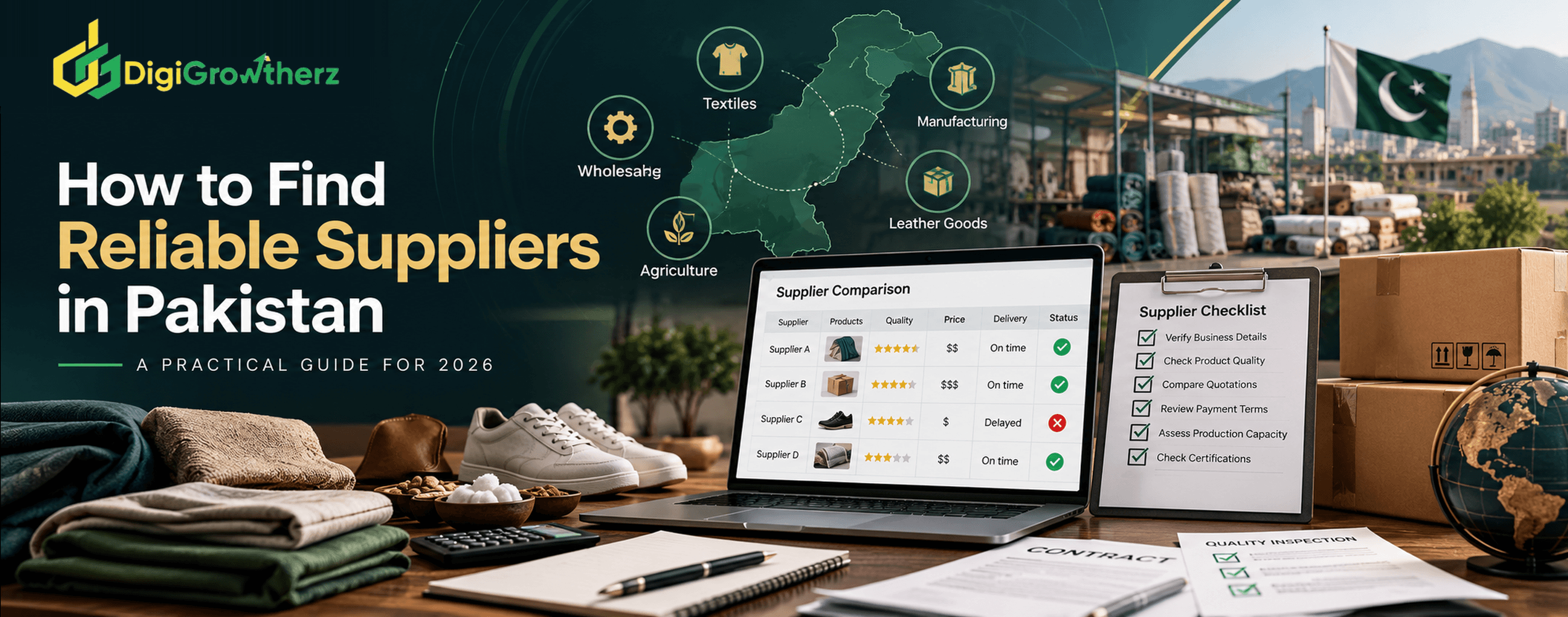
Looking for trustworthy manufacturers, wholesalers, or product suppliers in Pakistan? Learn how to find potential suppliers, verify business credentials, assess product quality, compare quotations, negotiate terms, and reduce the risk of unreliable deliveries or financial losses.